AI Automation for Businesses in India: How AI Can Transform Everyday Business Operations
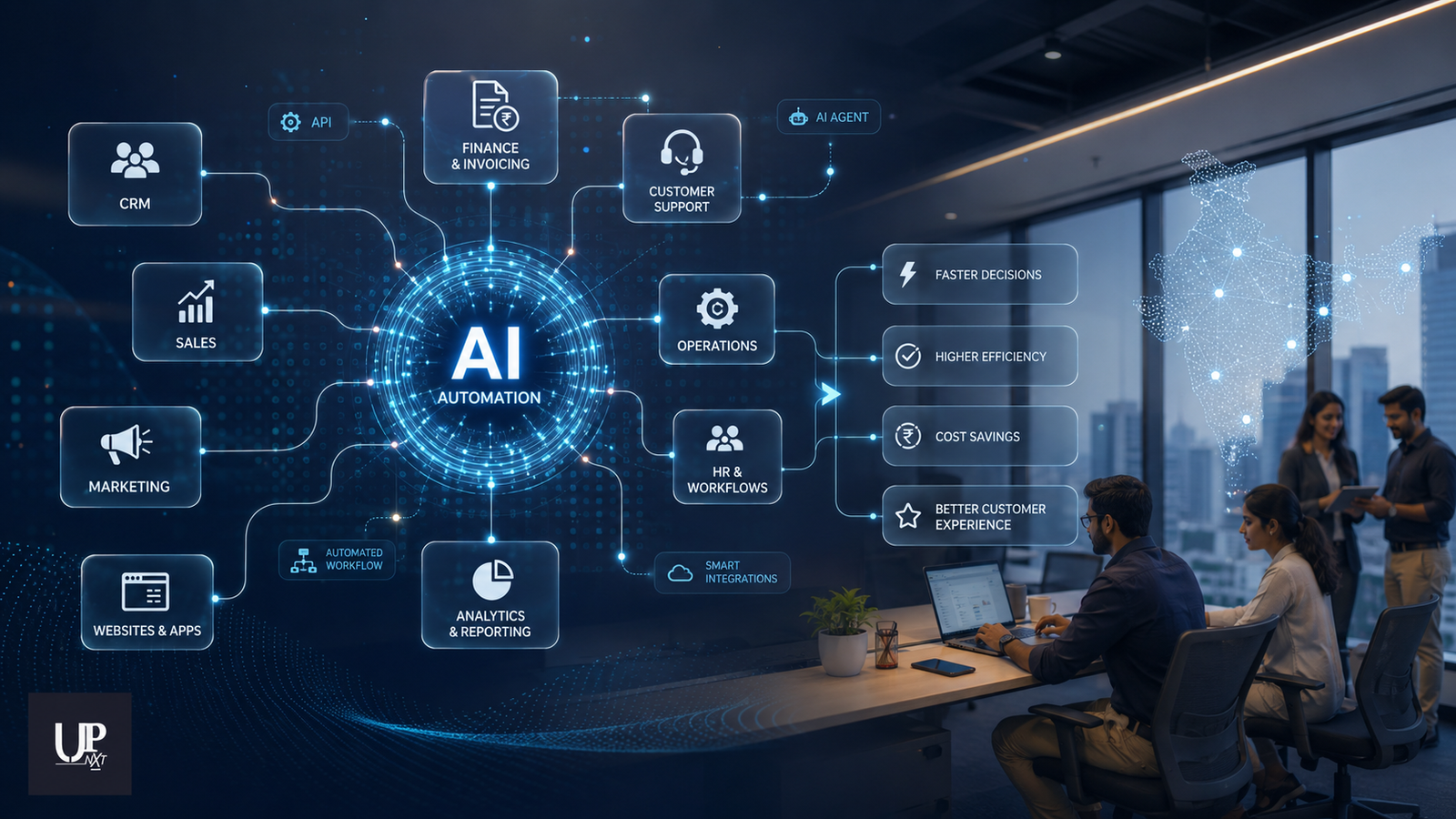
Artificial Intelligence is no longer limited to large technology companies. Businesses of all sizes in India are increasingly using AI automation to reduce manual work, improve productivity, and streamline everyday operations.
From handling customer enquiries and processing documents to managing sales workflows and generating reports, AI can automate tasks that previously required significant human effort.
For startups, SMEs, and growing businesses, the real opportunity is not simply using AI tools, but integrating AI into existing business processes to create smarter and more efficient workflows.
What Is AI Automation?
AI automation combines Artificial Intelligence with business process automation to perform tasks with minimal manual intervention.
Traditional automation generally follows predefined rules:
If X happens → perform Y.
AI-powered automation can go further by understanding information, identifying patterns, making decisions based on context, and taking appropriate actions.
For example, instead of manually reviewing every customer enquiry, an AI-powered system can:
- Read and understand the enquiry
- Identify the customer's requirement
- Categorize the lead
- Provide an initial response
- Update the CRM
- Notify the sales team
- Schedule a follow-up
This creates an end-to-end automated workflow rather than simply automating one individual task.
Why Are Indian Businesses Adopting AI Automation?
Businesses are under constant pressure to improve efficiency while controlling operational costs.
Many companies still spend valuable employee time on repetitive activities such as:
- Data entry
- Customer follow-ups
- Report generation
- Invoice processing
- Email management
- Lead qualification
- Document processing
- Internal approvals
- Customer support
- Data collection
AI automation can handle many of these repetitive processes, allowing employees to focus on decision-making, customer relationships, strategy, and other higher-value activities.
Where Can AI Automation Be Used?
AI automation can be implemented across almost every department of a business.
Sales Automation
AI can help sales teams automate several repetitive activities.
For example:
- Lead qualification
- Lead categorization
- Follow-up reminders
- CRM updates
- Customer communication
- Sales reporting
- Meeting scheduling
An AI system can analyze incoming leads and prioritize them based on predefined business criteria, helping sales teams focus on the opportunities most likely to convert.
Customer Support Automation
AI-powered customer support can handle common questions and routine requests without requiring employees to respond manually to every interaction.
AI can assist with:
- Frequently asked questions
- Order status enquiries
- Appointment requests
- Basic troubleshooting
- Customer information collection
- Ticket categorization
- Support escalation
More complex issues can automatically be transferred to a human employee.
This creates a hybrid support model where AI handles routine interactions while people focus on situations that require human judgment.
Marketing Automation
Marketing teams can also benefit from AI automation.
Businesses can automate parts of:
- Customer segmentation
- Content workflows
- Email campaigns
- Lead nurturing
- Campaign reporting
- Customer engagement
- Performance analysis
AI can analyze customer and campaign data to help businesses understand what is working and where improvements may be required.
Finance and Invoicing
Finance departments often deal with large amounts of repetitive data.
AI automation can assist with:
- Invoice processing
- Data extraction
- Payment reminders
- Expense categorization
- Financial reporting
- Document verification
For example, an AI system can extract relevant information from an invoice and automatically transfer it into the appropriate business system.
Internal Business Operations
AI automation is particularly useful for internal workflows.
Businesses can automate processes such as:
- Employee requests
- Approval workflows
- Document processing
- Internal notifications
- Task assignments
- Daily or weekly reports
- Data synchronization
Instead of employees repeatedly moving information between different systems, automated workflows can handle the process in the background.
AI Agents vs Traditional Automation
One of the major developments in AI automation is the use of AI agents.
Traditional automation generally performs predefined actions.
AI agents can understand a goal, analyze available information, determine the next step, and interact with connected systems to complete a task.
For example, consider a new customer enquiry.
A traditional workflow might simply send an automatic email.
An AI-powered agent could:
- Read the enquiry.
- Understand the customer's requirement.
- Identify the type of business or service required.
- Check available information in the CRM.
- Create or update the lead.
- Draft a personalized response.
- Notify the relevant salesperson.
- Schedule a follow-up.
This makes AI automation significantly more powerful for complex business processes.
Benefits of AI Automation for Businesses
Reduced Manual Work
Employees spend less time performing repetitive administrative tasks.
Improved Productivity
Teams can dedicate more time to activities that require creativity, judgment, and human interaction.
Faster Operations
Automated workflows can process information and perform routine actions much faster than manual processes.
Fewer Human Errors
Automating repetitive data-handling tasks can reduce errors caused by manual entry and repetitive work.
Better Customer Experience
Faster responses and more consistent service can improve the overall customer experience.
Scalable Operations
Automation allows businesses to handle increasing volumes of work without increasing manual effort at the same rate.
AI Automation Does Not Mean Replacing Employees
A common misconception is that implementing AI automation means replacing the workforce.
In many businesses, the better approach is to use AI as a productivity layer around existing teams.
AI can handle repetitive and predictable tasks while employees continue to manage:
- Important decisions
- Customer relationships
- Strategy
- Creative work
- Complex problem-solving
- Exceptions and unusual situations
The goal is not simply to remove people from a process.
The goal is to make people more productive by removing unnecessary manual work.
How Businesses Can Start With AI Automation
Businesses do not need to automate everything at once.
A practical approach is to start with one repetitive process.
Step 1: Identify Repetitive Tasks
Look for activities that employees perform repeatedly every day or every week.
Step 2: Map the Existing Workflow
Understand how information currently moves between employees, systems, spreadsheets, emails, and applications.
Step 3: Identify Automation Opportunities
Determine which steps can be automated using AI, APIs, workflows, or traditional automation.
Step 4: Start With a Small Use Case
Choose one process where automation can provide a measurable benefit.
Step 5: Connect Existing Systems
AI automation becomes more powerful when it can interact with existing business applications such as CRM systems, websites, accounting software, communication platforms, and internal tools.
Step 6: Measure the Results
Track improvements such as:
- Time saved
- Processing speed
- Number of manual tasks reduced
- Response time
- Operational cost
- Customer satisfaction
Once the first workflow proves successful, businesses can gradually automate additional processes.
Custom AI Automation vs Ready-Made AI Tools
There are thousands of AI tools available today, but not every business problem can be solved effectively by using an off-the-shelf application.
Ready-made tools can be useful for specific tasks.
However, businesses with unique workflows may benefit from custom AI automation integrated directly into their existing systems.
For example, a company may need an AI system that connects its website, CRM, internal database, communication tools, and business-specific workflows.
In such cases, custom development can provide greater control, flexibility, and scalability.
Building AI Automation With UpNXT IT Solutions
At UpNXT IT Solutions, we work on technology solutions that help businesses improve their digital operations through custom software, automation, AI-powered systems, and business applications.
Instead of treating AI as a standalone tool, businesses can integrate AI into their existing workflows and applications to solve specific operational problems.
Depending on the business requirement, this can include solutions involving:
- AI-powered business workflows
- AI agents
- Custom software systems
- CRM and internal tools
- Business process automation
- API integrations
- Automated customer interactions
- Data and document processing
The right solution depends on the existing business process, systems, data, and the specific outcome the business wants to achieve.
Is AI Automation Right for Your Business?
AI automation can be valuable for businesses that regularly deal with repetitive tasks, large amounts of data, multiple software systems, or time-consuming manual workflows.
However, automation should not be implemented simply because AI is popular.
The best starting point is to identify a genuine business problem and determine whether AI can solve it efficiently.
A well-designed automation system should ultimately help the business save time, reduce operational effort, improve accuracy, or deliver a better customer experience.
The Future of AI Automation in India
AI adoption in India is expected to continue growing as businesses become more comfortable integrating AI into everyday operations.
The next phase will move beyond individual AI tools toward connected AI-powered business systems that can understand information, communicate with other applications, and complete workflows with limited human intervention.
For businesses, this creates an opportunity to rethink how everyday work is performed.
The question is no longer simply:
"Can we use AI?"
Instead, businesses should ask:
"Which parts of our business can AI make faster, smarter, and more efficient?"
That is where AI automation can create real business value.